


Haven’t we all tried multiple techniques to manage our time better?
I have.
I have tried different tools, techniques and, almost every time, given up after a few days to few weeks.
I have been getting a lot of questions related to time management, with the WFH model making the work-life balance more of a work-life- blur.
the most common question is: where do I draw the line?
To me, it is not just one line, but possibly 2 – to create 3 buckets.
Over the years, what has worked well for me and something that I also recommend to everyone who feels that they need to manage their time better, is a 3 bucket formula.
Essentially, it boils down to having three logical buckets of time.
These buckets need not be – and most likely, they would not be – contiguous – or even timeboxed.
TImeboxing helps, provided you have flexibility on the scope. If not, it only adds to pressure to finish a fixed amount of work within that time. And you are nearly dead – of energy by that ime.
Is that the origin for the term deadline – I am not sure, but seems quite possible.
But, I am digressing..
What do you do in these three buckets and how can you maximize the return on time invested?
Here is a simple approach.
Group your day under three buckets.
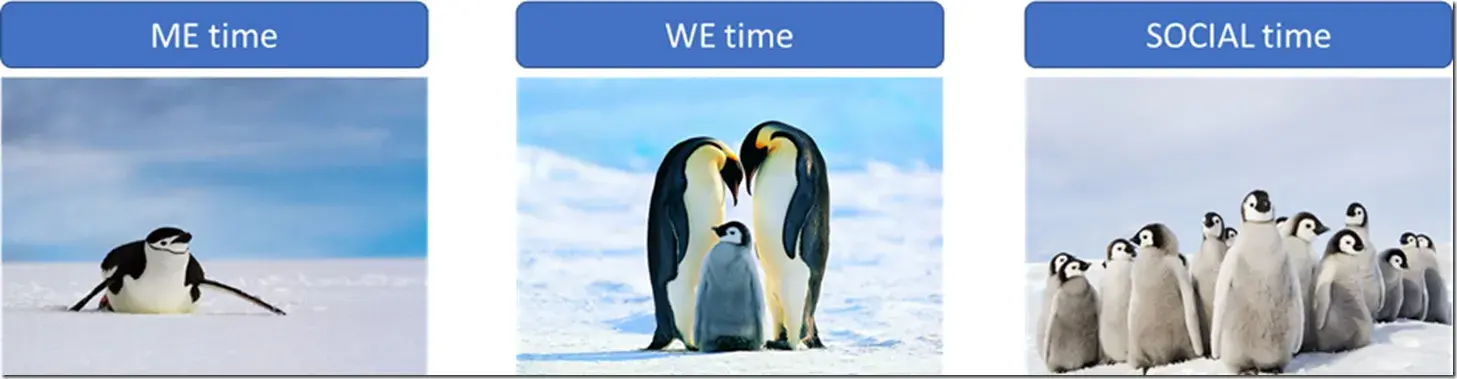
First – ME time.
this is time just for you and whatever you would do, all by yourself.There are no dependencies on others.
Examples are – thinking or experimentation at work, personal fitness activities, learning time etc.
Very broadly, whether related to work, family or yourself, this bucket is likely to take the most of your time on any day.
At work, this is time when you do not want to be disturbed. You might spend this time on any individual contributions, preparing for something: meeting, proposal, presentation, plans etc
Outside of work, this could include your fitness time: exercises, yoga, meditation, just sipping your coffee and catching up on the news.. whatever.This is time when you would like to be left alone.
In the WFH scenario, your ME time is likely to be a blend of work time as well as non-work time.
ME time is also a time to pause, reflect and recharge.
One of the techniques that has worked for me is journaling. writing things down – in any format: list, words, sentences, pictures, doodles, mindmaps.. choose what works best for you, to reflect, refine and recharge
Next is WE time.
the WE is the circle that you are closest to, or feel part of.
At home, this is the immediate family- the family that stays with you.
They also need your time – for meal times together, walks, playtime with kids or just engaging in some group activities .. cooking, cleaning, reading together etc
At work, this would be broadly ‘meetings’ with the team. planning, designing, reviewing, experimenting, executing etc, towards the common team goals.
WE time can be effectively used to derive energy from others – particularly in times when we may feel a little low, for some reason.
It is also a time to give back – share your energy with the others, in case anyone else is under pressure
The third is SOCIAL time – or the ALL or WORLD time.
At home this would include time for and with extended family, friends, neighbors [keeping social distance  ] etc.
At work, this would include water cooler time – to network with others outside your immediate team, department or company meetings such as townhalls or all-hands sessions or even planning, coordination with other teams.
This is also essential. we need to explore and experience beyond the little circles we may have drawn around us, both as a diversion and also as a source of learning.
I hope that these are simple tips that you can start adopting and refine as you go along.
Do share your experience with this approach as well as any others that have worked for you.